An observed fraction is not an official probability
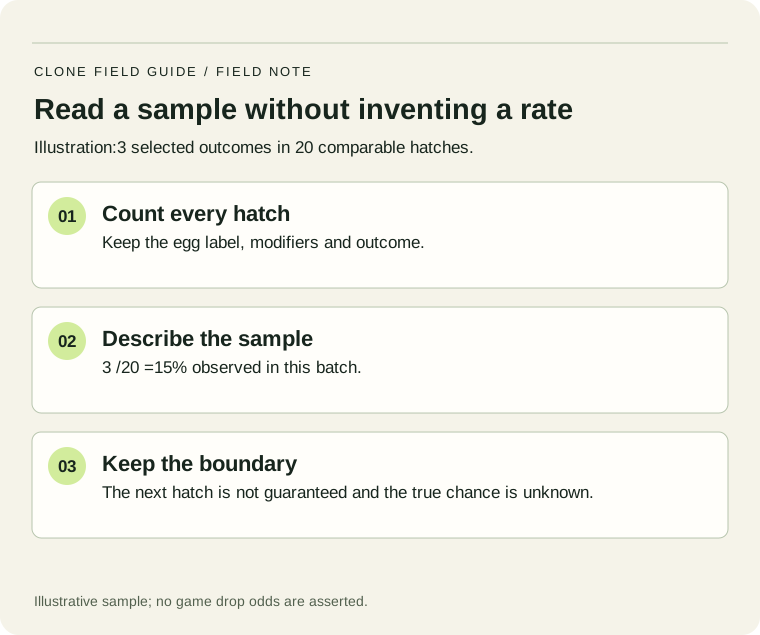
If three outcomes of interest appear in twenty comparable hatches, the observed fraction is 3/20, or 15%. It is a description of that sample, not a published 15% drop rate for the next egg. The current official description and pass-name directory checked by this guide do not supply a complete hatch-probability table.↗↗
Start by defining the outcome you want to count: a particular displayed pet label, variant or rarity. Keep the definition fixed across the batch. Do not change “success” afterward just because an unexpected hatch looks impressive; that changes what the recorded fraction means.
Record all outcomes, including ordinary ones
| Field | Why it matters |
|---|---|
| Egg source and exact label | Different inputs may have different outcome pools |
| Visible modifiers and timers | Avoid mixing unlike conditions |
| Every result in order | Prevent selection of only the impressive hatches |
| Outcome definition and total count | Make numerator and denominator clear |
The September videos contain edited play, paid purchases and boosts. A montage of several unusual results is not a random sample of all hatches. The missing ordinary outcomes and changing setup prevent using the video’s pace to estimate a reliable probability.
A Luck item name does not document whether it changes rarity probabilities, which outcomes it affects or how it combines with another modifier. Inspect the live item text first. If the relevant rule is unstated, you can still record the conditions, but you cannot derive a multiplier merely from two short batches.
No result in a small batch is not proof of impossibility
For a purely illustrative 1% independent chance, the probability of seeing zero selected outcomes in twenty trials is 0.99 raised to 20, about 81.8%. This is not a game drop rate; it shows why a small unsuccessful batch cannot by itself prove a rare outcome is unavailable or that a boost is broken.
The independence and equal-chance assumptions matter. If the game has changing pools, guarantees, progress counters or another rule, a simple repeated-trial model may not apply. Do not assume such systems exist, but do not erase their possibility when the rules are unknown.
- Choose an outcome definition and comparable egg label before starting.
- Record the setup and each result, not only the notable ones.
- Count the observed fraction after the batch.
- Separate batches when an item expires or conditions change.
- Report the sample size and uncertainty alongside the fraction.
For two samples, compare the input conditions before comparing percentages. Two out of ten and four out of twenty are both 20%, yet neither establishes a guaranteed chance. A larger recorded batch can be more informative, but a mixed or selectively reported batch does not become trustworthy simply because its count is large.
Use the worksheet for observation, not as a reason to consume valuable items or buy eggs solely to fill a table. If your purpose is income rather than probability research, the best-pet and sell-or-hatch guides address the decision without requiring an invented rarity ranking.
Keep edited hatch footage separate from a sample
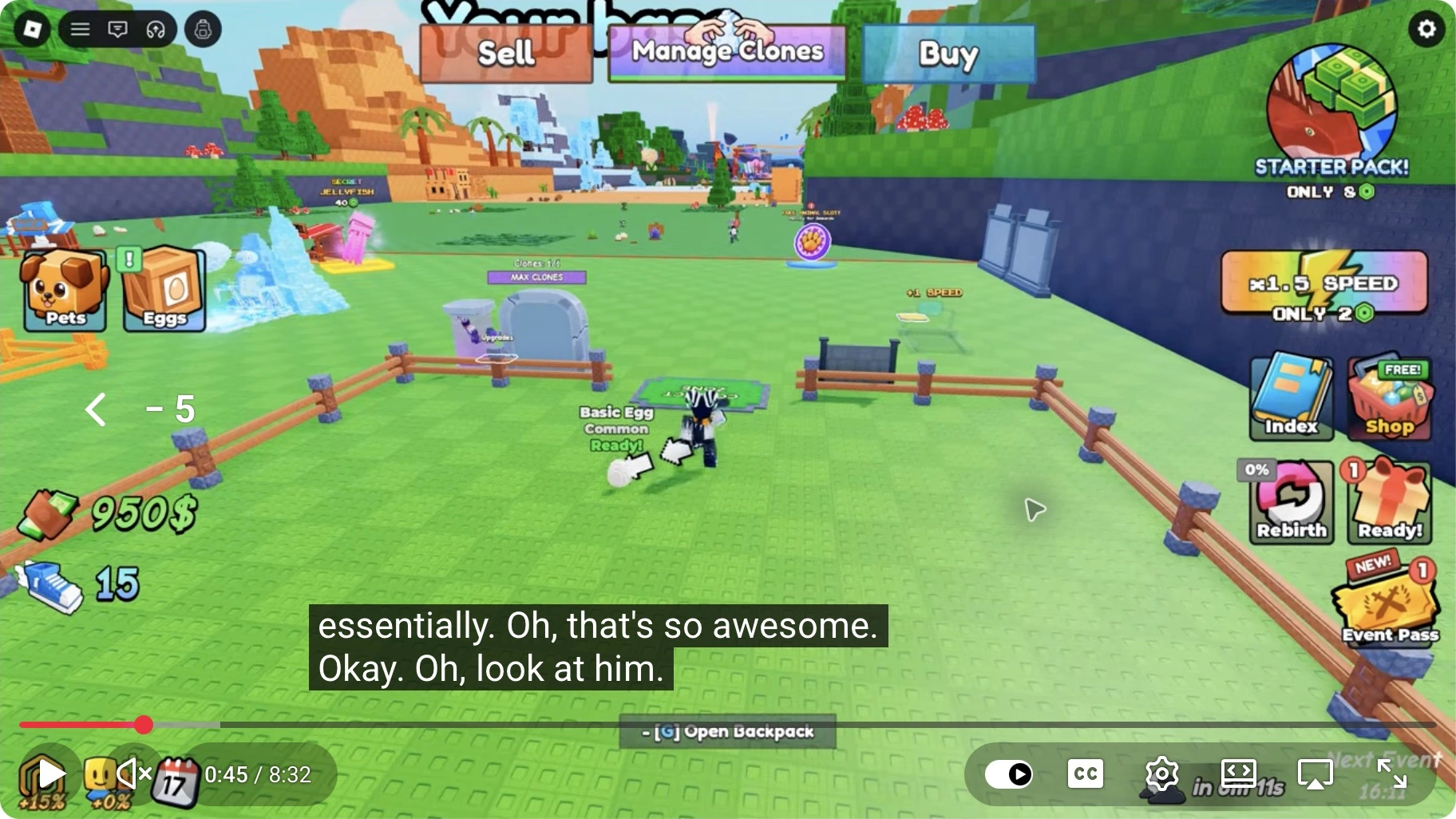
The creator opens eggs in a progressed, paid September session. This is context for identifying the observed results, not a controlled probability experiment.↗
Starting Over as NOOB with MOST EXPENSIVE TREADMILL in Clone to Steal Eggs! ↗
LukeBlox · 23 September 2026
Loading the player connects to YouTube. We use its privacy-enhanced player; YouTube may show its own ads. Privacy details.
What to look for
- 4:37An edited hatch sequence
The creator discusses ready and stored eggs. The surrounding account changes prevent treating the clip as an odds test.
Keep a useful record
Use the short worksheet for this decision. Fill only the fields you can read or measure; leave an uncertain result marked unknown. A second observation is useful only when you can compare the same setup. Keep the date with your readings so a later balance change does not silently turn an old result into a current rule.
Read video hatch claims without turning them into odds
A rare hatch in a playthrough is a useful item sighting, but a highlight reel does not report all failed attempts. Record the complete number of comparable hatches, the egg type, active Luck effects and the number of each outcome before calculating a sample rate.
For example, two rare outcomes in 100 comparable hatches gives a 2% observed sample frequency. That is an arithmetic example, not this game’s published rate. If the creator cuts away or changes boosts, split the samples or leave the rate unknown.
Understand a zero-result sample without claiming impossible odds
Added 24 October 2026. Numerical examples below are hypothetical planning exercises, not a new gameplay test.
| Hypothetical sample | What you observed | What remains uncertain |
|---|---|---|
| 0 desired results in 50 comparable hatches | Observed frequency: 0 ÷ 50 = 0% | The underlying probability is not established as zero. |
| An assumed 1% probability | Probability of no hits in 50: 0.99^50 ≈ 60.5% | An illustration assuming independent, constant-probability rolls. |
| Same assumed probability, 100 hatches | Chance of at least one: 1 − 0.99^100 ≈ 63.4% | Not a guarantee of a result by the hundredth hatch. |
| Boost or egg type changes halfway | Split the records into comparable groups | Do not combine different conditions into a single published drop-rate claim. |
The 1% input above is invented solely to explain probability; it is not this game’s hatch rate. Independence and a constant probability are assumptions, and we have not established whether any hidden guarantee exists. Record full consecutive attempts instead of counting only the hatches retained in a highlight video.
Keep failed attempts in the sample
Write one row for every consecutive comparable hatch, including ordinary outcomes. Record egg type and boost changes at the moment they happen. A video showing three desirable hatches without the unsuccessful attempts does not provide a denominator. If you missed part of the sequence, label the sample incomplete instead of reconstructing the missing attempts from memory.
Sources & scope
- Official Roblox experience description and identityChecked 15 October 2026
- Official Roblox universe pass directory — public listing snapshotPublic response checked 15 October 2026; not an account checkout quote
- Superlex Plays — first clone, ready egg and earning pet · 0:00–1:01Late September 2026 · inspected 2 October 2026
- LukeBlox — later egg openings, target discussion, Auto Hatch and passes23 September 2026; original transcript captured and reviewed in October
Written 15 October 2026. Official game and pass-directory data were checked today. Credited screenshots and video notes describe September recordings, not a current-server playtest. Worked examples are editorial calculations, not current game prices or tested drop odds. How we handle evidence.