Compare two outcomes, not two rarity labels
When your current client offers a sale, record that actual amount before comparing it with hatching. The sale is immediate cash; the hatch outcome may be uncertain and may need an available earning position. The official game description identifies pets as the earning layer, but it does not publish a complete egg-sale or drop-rate table.↗
A useful comparison asks whether an egg could improve the setup you have now. A pet that replaces a similar earner produces a smaller marginal change than one that fills an empty position. A collectible you want to keep can also be valuable for a different reason, so state whether the goal is cash, collection or another task.

Find the income needed to match the sale
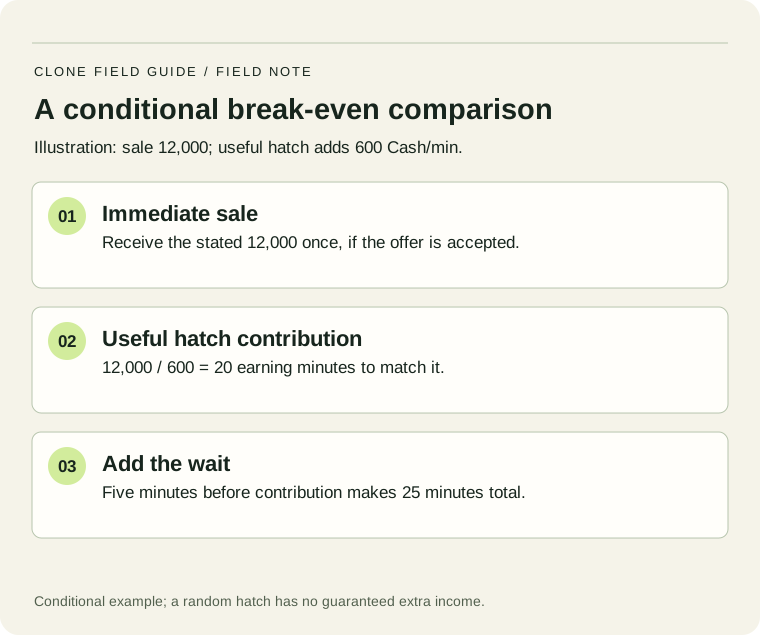
For a worked illustration, suppose a sale offers 12,000 Cash and a useful hatch would add 600 Cash per minute to your ordinary income. Matching the sale takes 12,000 ÷ 600 = 20 minutes after that contribution begins. If readiness or another step takes five minutes first, the total becomes 25 minutes under those assumptions. These numbers are not actual offers or a predicted hatch result.
| Input | Use |
|---|---|
| Actual sale amount | Certain offer if available and accepted |
| Time until a pet could contribute | Delay before recurring benefit begins |
| Marginal Cash/min | Added income after replacement effects |
| Your planning horizon | Whether the benefit arrives in time for the goal |
If you do not know what will hatch or whether it can contribute, leave the income estimate unknown. A rare result from a creator’s montage cannot supply a reliable expected value. It is better to keep a collection decision separate than to invent an average reward to make a calculator produce an answer.
Apply the comparison to the next purchase
- Write the next cash goal and how close you are to it.
- Read the live sale option, if there is one, without activating a bulk action.
- Check whether you have a free earning position or a weaker pet to replace.
- Use a conservative marginal contribution only when you have a defensible basis for it.
- Include hatch and placement delay, then decide which outcome serves your goal.
A sale may help buy a specific upgrade sooner, while a useful hatch may improve repeated earnings later. Those are different horizons. If an immediate purchase changes training or unlocks a target, its value cannot be reduced to a pet-income comparison without observing the later result.
Keep sale proceeds out of a clean ordinary-income interval. An illustrative wallet that rises by 18,000 while a 12,000 sale occurs contains only 6,000 from other sources before accounting for any additional spending or rewards. Treating the entire wallet increase as passive pet income would exaggerate every later estimate.
Before using Sell All or an auto-sell option, inspect the scope in your current client. This page does not establish which eggs or pets such controls protect, whether they act on already selected items, or whether a sale can be reversed. Use a single identifiable item if you want an observation you can explain.
See the income state after a hatch
These historical moments show a ready egg and a following pet-income state. They do not establish a sale price or guaranteed hatch outcome.↗
ROBLOX CLONE TO STEAL EGGS.. ↗
Superlex Plays · Late September 2026
Loading the player connects to YouTube. We use its privacy-enhanced player; YouTube may show its own ads. Privacy details.
What to look for
- 0:45Ready egg
Identify the egg before it becomes a pet.
- 0:50Pet income label
Use the visible rate as an account-specific reading, not a universal species value.
Keep a useful record
Use the short worksheet for this decision. Fill only the fields you can read or measure; leave an uncertain result marked unknown. A second observation is useful only when you can compare the same setup. Keep the date with your readings so a later balance change does not silently turn an old result into a current rule.
Compare a sale with the remaining useful session
Added 24 October 2026. Numerical examples below are hypothetical planning exercises, not a new gameplay test.
| Hypothetical input | Calculation | Decision boundary |
|---|---|---|
| Sell one egg for 12,000 Cash | Immediate cash: 12,000 | Use the actual sale offer when applying the example. |
| A hatch might add 300 Cash/min | 12,000 ÷ 300 = 40 minutes | Forty minutes of sustained additional income would match the sale. |
| Only 15 useful minutes remain | 300 × 15 = 4,500 Cash | Under these assumptions, the income alone would not match the sale. |
| The hatch outcome is unknown | Keep the break-even calculation conditional | No expected-value answer without credible outcome probabilities. |
A collection goal can change the choice. Before a bulk sale or any automatic selling option, check the selected categories and whether special variants are included. Test with one low-value item you are willing to sell; do not use a rare egg to discover how a filter works. The calculation excludes collection rewards and later upgrades.
Keep a reversible inventory plan before a bulk action
Separate items into keep, inspect and willing-to-sell groups before selecting any bulk option. Confirm what the action targets, then review the selection count. If you cannot establish whether variants or collection items are included, stop at a single low-value item you are willing to lose. The purpose is to make a decision you understand; this guide does not promise that a sale can be undone.
Sources & scope
- Official Roblox experience description and identityChecked 15 October 2026
- Superlex Plays — first clone, ready egg and earning pet · 0:00–1:01Late September 2026 · inspected 2 October 2026
Written 15 October 2026. Official game and pass-directory data were checked today. Credited screenshots and video notes describe September recordings, not a current-server playtest. Worked examples are editorial calculations, not current game prices or tested drop odds. How we handle evidence.