Match the item to a task you can observe
Current publisher listings associate UPD1 with a Cash Potion, TRAIN1 with a Train Potion and LUCK1 with a Luck Potion. FIX1 has a reward disagreement across sources. These listings identify reported rewards; they do not establish duration, exact strength, stacking rules or successful redemption on your account.↗
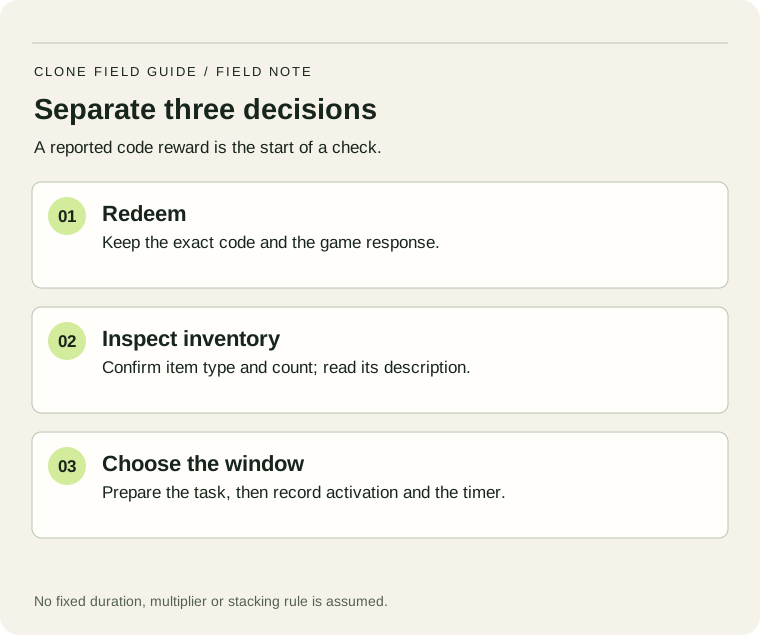
First verify what you received, then read the item description and current controls. Receiving a potion does not by itself prove that a boost is active. Before choosing to use it, have the corresponding task ready: a stable income setup, a training interval or a clearly recorded hatch batch.
Plan the observation before the timer
| Potion label | Record before use | Do not assume |
|---|---|---|
| Cash | Ordinary Cash/min, pets and base state | The same rate continues after expiry |
| Train | Equipped treadmill and Speed/s | A training change is cash income |
| Luck | Egg labels, batch size and outcomes | One rare result proves exact odds |
Cash windows: compare before, during and after
Take a clean baseline with no purchases, sales or one-off rewards. If you activate a cash item, note the time and displayed timer, keep the pet setup fixed and take a comparable reading while the effect is active. Repeat after it ends. A video of a pet label is context for reading units, not proof of a potion multiplier.
As an illustration, 6,000 earned in two minutes is 3,000 per minute. A second 12,000 interval over two minutes is 6,000 per minute. If the second interval had the same setup apart from a boost, the measured ratio is two. If pets changed or a reward arrived, you cannot assign that ratio to the item without accounting for those changes. This is an example, not a stated in-game effect.
Training and luck need different evidence
For a Train item, compare the speed difference over elapsed seconds on the same machine. Keep pre-boost and post-boost readings separate. If the timer expires mid-observation, break the calculation into windows instead of using a blended rate to predict the next target.
For a Luck item, the short-term observation is the batch of outcomes, not the wallet. Record egg labels, count and results, plus all visible modifiers. A few hatches cannot recover an exact probability or prove that a favorable result was caused by the item. An unlucky batch also does not establish that an item did nothing.
- Read the effect text and timer without relying on the code name.
- Prepare the intended activity before choosing to activate.
- Keep other modifiers and purchases unchanged where possible.
- Record the actual window and any interruption.
- Compare only what you measured; leave duration or stacking questions unknown when not stated.
Do not activate a second item merely to discover whether timers stack. Read the current explanation first and decide whether consuming another item is worthwhile. If the game does not state how two effects combine, this guide does not fill the gap with a generic “all boosts stack” rule.
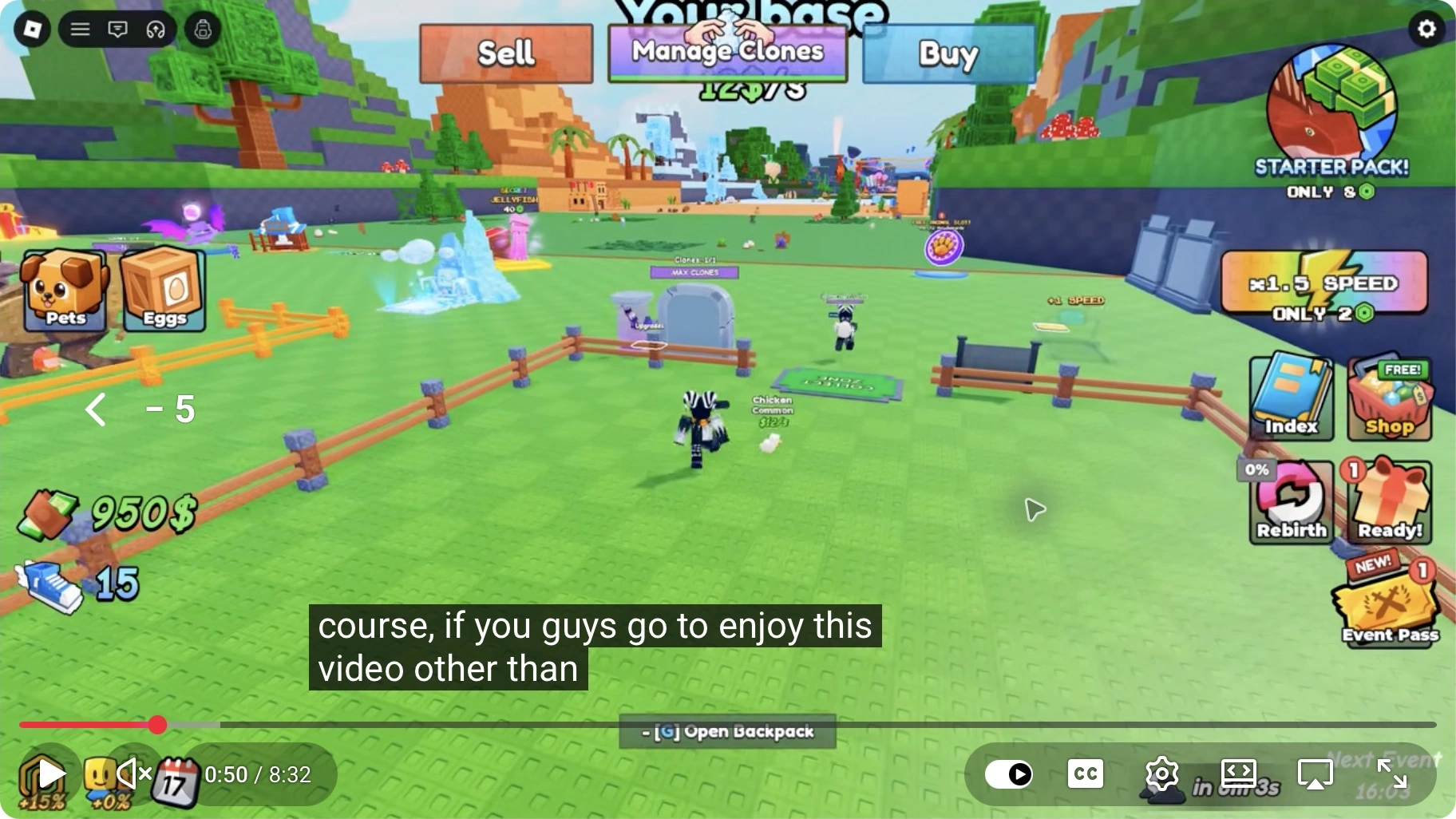
Read Cash units before a boost test
This scene demonstrates the readings to identify before a cash observation. No potion activation or effect is demonstrated here.↗
ROBLOX CLONE TO STEAL EGGS.. ↗
Superlex Plays · Late September 2026
Loading the player connects to YouTube. We use its privacy-enhanced player; YouTube may show its own ads. Privacy details.
What to look for
- 0:50Wallet versus rate
Use the wallet as a balance and /s labels as rates. Keep your own boost test separate.
Keep a useful record
Use the short worksheet for this decision. Fill only the fields you can read or measure; leave an uncertain result marked unknown. A second observation is useful only when you can compare the same setup. Keep the date with your readings so a later balance change does not silently turn an old result into a current rule.
Split one session at the boost boundary
Added 20 October 2026. The procedure below is our editorial planning method; any numerical example is hypothetical.
| Your own record | Worked example | How to calculate |
|---|---|---|
| Ordinary income | 600 Cash/min | Keep this as the baseline. |
| Temporary measured income | 900 Cash/min for 3 minutes | This is a hypothetical observed rate, not a claimed potion effect. |
| Remaining ordinary session | 7 minutes at 600 Cash/min | Do not keep applying the temporary rate. |
| Ten-minute session total | 3 × 900 + 7 × 600 = 6,900 Cash | The extra over a 6,000 baseline is 900 Cash. |
Before activation, finish menu setup and note what the actual item says it affects and how long remains. A new code with an unspecified reward is not evidence for a new potion type. Separate claiming an item, activating it and measuring its effect.
Sources & scope
- Roblox Den — reported codes and redemption interfaceRead 14 October 2026; publisher check shown 13 October 20:31 UTC
- Official Roblox experience — identity and descriptionChecked 14 October 2026
- Superlex Plays — first clone, ready egg and earning pet · 0:00–1:01Late September 2026 · inspected 2 October 2026
Written 14 October 2026. Official identity and description were rechecked today. Gameplay stills and timestamp notes refer to the credited September recordings; they are not a new playtest. Worked numbers marked illustrative are planning examples, not current game prices. How we handle evidence.