More deliveries are not automatically more income
Count the eggs that actually arrive during a fixed interval, then count the ones opened or otherwise removed. The result tells you whether a queue is growing. Cash income is a later measurement: an opened pet may fill a position, replace an existing earner or remain outside the contributing setup.
The official description connects clones with egg stealing and pets with cash. The reviewed upgrade menu separates summoning speed, clone count and steals. Neither source establishes that doubling one control instantly doubles ordinary cash income. Use a short flow record before attributing a wallet change to the clone system.↗↗

Account for the queue
| Event | Egg count |
|---|---|
| Waiting at the start | 4 |
| Delivered during the interval | +12 |
| Opened during the interval | −8 |
| Sold or otherwise removed | −2 |
| Waiting at the end | 6 |
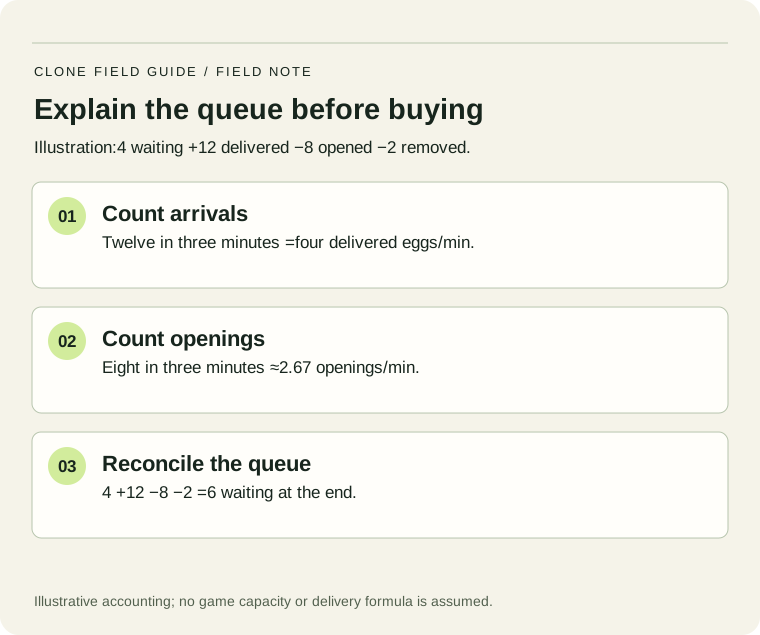
This accounting requires one consistent boundary. Decide whether waiting eggs includes inventory, placed eggs or both, and keep that definition unchanged. Do not count an egg moving from inventory into the base as a new delivery if it was already inside the chosen queue.
A growing queue can mean delivery is ahead of opening, but it does not prove an Auto Hatch purchase is needed. Timers, an outstanding manual action, a chosen collection strategy or another limit may explain the state. Observe the step before comparing a convenience offer.
Measure a change without mixing the outputs
- Define the queue and count waiting eggs at the start.
- Record elapsed time and all completed deliveries.
- Count openings and any sales or removals separately.
- Count waiting eggs at the end and reconcile the totals.
- If you change one upgrade, repeat a comparable interval before comparing rates.
If a three-minute interval produces twelve returns, the observed delivery rate is four per minute. An illustrative second interval with fifteen returns is five per minute. That is a 25% rise in measured deliveries, but it is not a verified 25% cash increase. Pet selection, random outcomes, boosts and active capacity can all change the later conversion into ordinary earnings.
If totals do not reconcile, first look for a missed opening, sale, carryover egg or change in the queue definition. A mismatch is a reason to improve the record, not proof that the game deleted an item. Shorter intervals with identifiable eggs are often easier to explain than a long busy session.
Use two measures for a purchase decision: the flow improvement you observed and the ordinary Cash/min afterward. Some changes save attention or allow a collection target without a large immediate cash effect. Record that benefit directly rather than inventing an income multiplier.
Keep temporary boosts and target changes in the note. A different target may take longer but serve a specific egg goal. An expiring item can alter rates mid-interval. Compare the same task under comparable conditions, and split the record when those conditions change.
Identify the separate clone controls
This menu shows separate summoning, count and steal controls. It is not a timed delivery or cash-income test.↗
ROBLOX CLONE TO STEAL EGGS.. ↗
Superlex Plays · Late September 2026
Loading the player connects to YouTube. We use its privacy-enhanced player; YouTube may show its own ads. Privacy details.
What to look for
- 1:29Choose one variable
Read the three menu meanings before changing more than one control.
Keep a useful record
Use the short worksheet for this decision. Fill only the fields you can read or measure; leave an uncertain result marked unknown. A second observation is useful only when you can compare the same setup. Keep the date with your readings so a later balance change does not silently turn an old result into a current rule.
Use queue growth to locate the limiting stage
Added 24 October 2026. Numerical examples below are hypothetical planning exercises, not a new gameplay test.
| Hypothetical five-minute record | Rate | Interpretation |
|---|---|---|
| 20 eggs returned, 12 opened | Arrival 4/min; completion 2.4/min | The waiting queue grows by 8 eggs, or 1.6/min. |
| Faster delivery, unchanged opening rate | More than 4/min arriving; still 2.4/min opened | The hatch backlog grows faster. |
| Opening rises to 4/min with arrival unchanged | Arrival equals completion | The queue stops growing under these steady assumptions. |
| Existing queue: 10 eggs; completion 5/min; arrival 4/min | Net drain 1/min; about 10 minutes to clear | Count new arrivals when estimating clearance time. |
Record beginning and ending queue sizes alongside returns and opens. Keep any sold or removed eggs in a separate column; otherwise they can look like successful hatches. The examples ignore changing timers and space constraints, so recalculate when the setup changes.
Separate a fast burst from a sustained rate
Measure at least two equal windows and record the queue at every boundary. An initial burst may use eggs already waiting, so it should not be interpreted as a sustainable arrival rate. If arrivals average 3 per minute while opens briefly reach 6, the starting queue can explain the difference. Those numbers are hypothetical; repeat with your own uninterrupted observations.
Sources & scope
- Official Roblox experience description and identityChecked 15 October 2026
- Superlex Plays — Portal, Number of Clones and Steal descriptions · 1:26–1:34Late September 2026 · inspected 2 October 2026
Written 15 October 2026. Official game and pass-directory data were checked today. Credited screenshots and video notes describe September recordings, not a current-server playtest. Worked examples are editorial calculations, not current game prices or tested drop odds. How we handle evidence.