The best earner needs a fair comparison
For an income decision, compare the cash rates available from your own pets under the same account conditions. A pet shown on an advanced account cannot be ranked fairly against one on a new account if base bonuses, rebirth and temporary boosts differ. Keep collection goals separate from the cash comparison.
The official description establishes pets as a source of cash. The reviewed gameplay gives concrete account examples rather than a complete species table. A Chicken and base show 12/s in the Superlex scene, while the LukeBlox base example shows the same pets with changing displayed rates after a purchase.↗↗↗

Build a small table from your account
| Field | Why it matters |
|---|---|
| Pet name and visible variant | Keep different labels identifiable |
| Displayed rate and unit | Compare Cash/s with Cash/s |
| Base and rebirth state | Avoid mixing different account bonuses |
| Active boost and remaining time | Keep temporary rates separate |
| Selection or placement state | Confirm the pet is actually contributing |
Test one change at a time
- Record the base rate and current contributing pets.
- Identify the candidate pet and read its displayed rate.
- Make one selection or placement change using the controls available in your client.
- Check the resulting base state and rate.
- Take a clean timed reading if you need a reliable number for a purchase comparison.
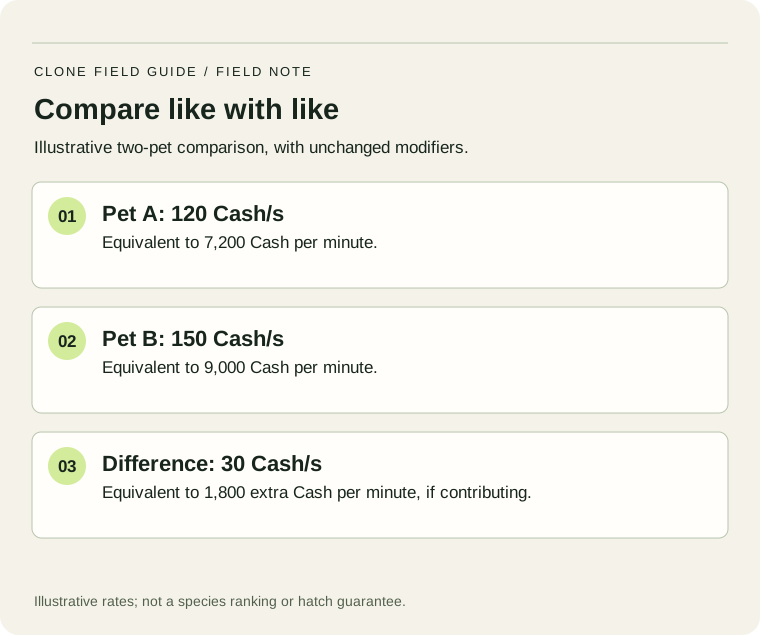
Suppose two illustrative pets show 120/s and 150/s in identical conditions. The difference is 30/s, or 1,800 per minute. That arithmetic is useful only if the second pet replaces the first in the earning setup. It is not an extra 1,800 per minute if both were already contributing, the displayed rate includes another changed bonus, or the replacement was never applied.
A code reward is another route to a candidate pet, not proof that it is your best earner. The code sources report Yeti for Magia and Lizard for Release; check actual inventory and compare the resulting labels before changing your setup. The guide has not redeemed those codes, and a publisher’s reward listing cannot substitute for your own inventory result.
Avoid selling a pet because an outside tier list labels it weak. First check its contribution, whether you want to keep it for collection and what the game says the sale will do. If the current controls offer a bulk action, read its scope before using it. This guide does not assume that every version protects selected pets or allows a sale to be reversed.
An attractive rarity or mutation label is worth recording, but it does not supply an exact multiplier by itself. Without a comparable sample, keep the effect unknown. A useful best-pet note tells the reader what was compared and under which modifiers, rather than turning unrelated screenshots into a universal ranking.
Read a pet rate in context
Use this scene to distinguish a pet rate, the base rate and the wallet. It is not a pet tier-list test.↗
ROBLOX CLONE TO STEAL EGGS.. ↗
Superlex Plays · Late September 2026
Loading the player connects to YouTube. We use its privacy-enhanced player; YouTube may show its own ads. Privacy details.
What to look for
- 0:50Three readings on one screen
Chicken and base each show 12 Cash/s; the wallet shows 950 Cash in this recorded setup.
Keep a useful record
Use the short worksheet for this decision. Fill only the fields you can read or measure; leave an uncertain result marked unknown. A second observation is useful only when you can compare the same setup. Keep the date with your readings so a later balance change does not silently turn an old result into a current rule.
Compare the marginal gain from replacing one contributor
Added 20 October 2026. The procedure below is our editorial planning method; any numerical example is hypothetical.
| Hypothetical measurement | Calculation | Interpretation |
|---|---|---|
| Current contributing pet: 90 Cash/s; replacement: 120 Cash/s | 120 − 90 = 30 Cash/s | The gain is 30, not the replacement’s full 120. |
| Gain per minute | 30 × 60 = 1,800 Cash/min | Use matching units when comparing a cost. |
| Example cost: 36,000 Cash | 36,000 ÷ 1,800 = 20 minutes | Simple recovery estimate only if the gain is sustained. |
| A collection goal instead of income | Record it separately | A collection decision need not maximize current Cash. |
Compare pets in the same active setup with the same boosts. If replacing one pet changes a multiplier or another effect, measure the total setup before and after instead of summing incomparable labels. No current best-pet tier list is implied.
Sources & scope
- Official Roblox experience — identity and descriptionChecked 14 October 2026
- Superlex Plays — first clone, ready egg and earning pet · 0:00–1:01Late September 2026 · inspected 2 October 2026
- LukeBlox — one 5M base upgrade and pet income labels · 3:0023 September 2026 · frames inspected 3 October 2026
- Roblox Den — reported codes and redemption interfaceRead 14 October 2026; publisher check shown 13 October 20:31 UTC
Written 14 October 2026. Official identity and description were rechecked today. Gameplay stills and timestamp notes refer to the credited September recordings; they are not a new playtest. Worked numbers marked illustrative are planning examples, not current game prices. How we handle evidence.